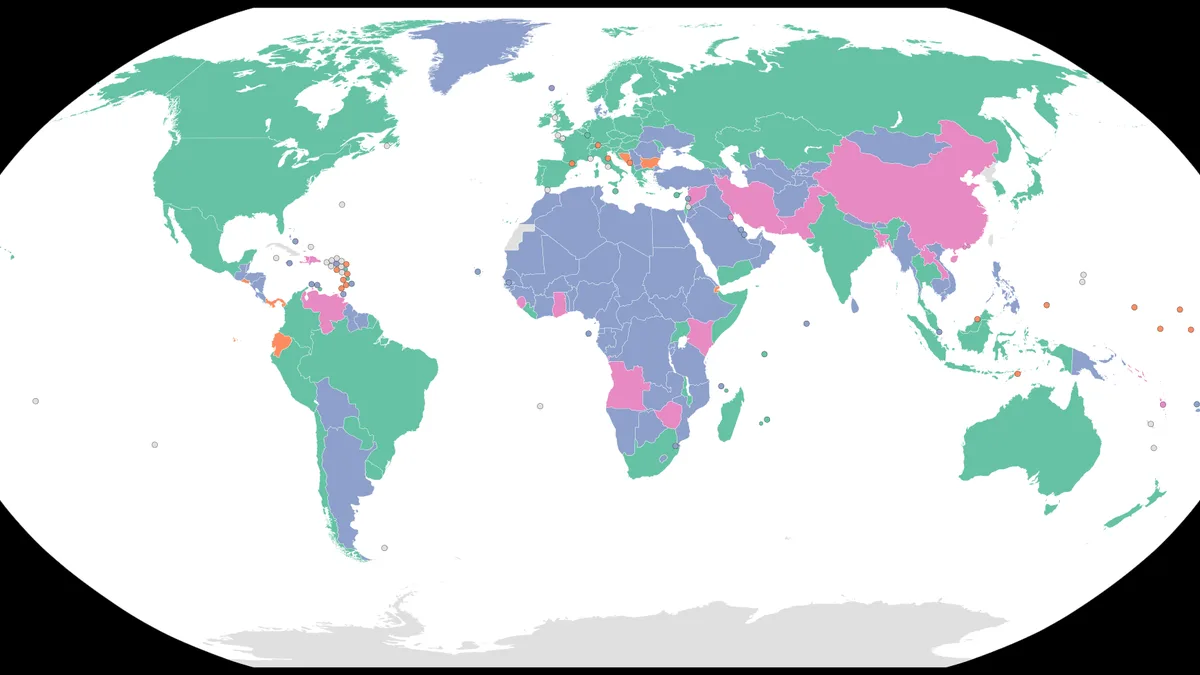
Fixed And Floating Rates By Market
| City market | Fixed and floating rates |
|---|---|
| Yield | Varies by instrument and market conditions |
| Foreign buyer access | Depends on local regulations |
| Typical instruments | Government bonds, interest rate swaps, FRNs |
| Market type | Financial exchange |
| Primary participants | Institutional investors, banks, dealers |
| Trading hours | Aligns with local business hours |
| Settlement cycle | T+2 or as per market convention |
Origin and history
Fixed and floating exchange rates are not a single market but a fundamental framework of international finance. The concepts originate from the global economic system established in the mid-20th century. The system of fixed rates, specifically, was formally architected with the Bretton Woods Agreement in 1944, which pegged major currencies to the US dollar. This system dominated international trade until its collapse in the early 1970s. Following that collapse, many major economies, including the United States and Japan, transitioned to floating exchange rate regimes. The choice between these systems remains a core policy decision for national governments and central banks, shaping individual currency markets to this day.
What it is for
This framework governs how a country's currency value is determined in the foreign exchange market. A fixed exchange rate system is used to provide stability and predictability for international trade and investment by pegging a currency to another currency or a basket of currencies. A floating exchange rate system allows a currency's value to be set by the private market through supply and demand relative to other currencies. The choice between systems serves as a tool for achieving national economic objectives, such as controlling inflation or maintaining export competitiveness. This framework is essential for understanding the risk profile and operational mechanics of any national currency market. It directly impacts the yield environment for assets denominated in that currency.
Overview
In a fixed-rate regime, a country's central bank or monetary authority actively buys and sells its own currency to maintain the peg at a specific value. This requires the authority to hold large reserves of foreign currency. In a floating-rate regime, the currency's value fluctuates constantly based on market forces, though central banks may still intervene occasionally as "managed floats." The yield environment in a fixed-rate market is often more stable but typically offers lower returns, as interest rates are managed to maintain the peg. In a floating-rate market, yields can be higher to compensate for currency volatility but are subject to greater uncertainty. Most major global financial hubs operate with floating currencies, while some smaller economies or currency unions maintain fixed regimes.
What to know
A foreign investor must first identify which regime governs the target market's currency, as this dictates the primary risk. In a strictly fixed-rate market, the yield on local assets is often suppressed, and the risk of a sudden, large devaluation or re-pegging event exists. In a floating-rate market, currency volatility itself can erase or enhance investment gains, making hedging strategies a critical consideration. Foreigners can typically buy assets in both types of markets, but capital controls are more frequently employed in fixed-rate regimes to defend the peg. The decision to invest hinges not just on the local asset yield but on the combined return adjusted for expected currency movement. Understanding the central bank's credibility and level of foreign reserves is paramount in a fixed-rate market.
Common questions
Investors commonly ask whether a floating currency is riskier than a fixed one, to which the answer is that the risks are different rather than strictly higher or lower. Another frequent question is whether foreigners can freely repatriate profits, which depends on the specific capital controls of the country, not solely its exchange rate regime. Many inquire if a fixed peg is guaranteed to hold, and the clear answer is no, as history shows even strong pegs can break under sufficient economic pressure. Questions arise about how to hedge currency risk in a floating market, which involves financial instruments like forward contracts or options. Investors often ask which regime offers higher yields, but floating markets only potentially offer higher nominal yields, not necessarily higher risk-adjusted returns. A final common question is who decides the regime, which is a sovereign policy choice made by the nation's monetary authorities.
Pros and cons
The primary pro of a fixed-rate regime is stability for international business planning and lower transaction costs. A major con is that it removes an important economic adjustment mechanism, potentially leading to trade imbalances and requiring painful domestic austerity to defend the peg. Investors in fixed-rate markets often regret their choice when a devaluation occurs, wiping out their local currency gains upon conversion. The pro of a floating rate is its automatic adjustment to economic shocks and independence in monetary policy. The con is the inherent volatility, which can deter long-term investment and complicate budgeting for importers and exporters. A common mistake for foreigners is chasing high nominal yields in a fixed-rate market without adequately pricing in the latent devaluation risk, or conversely, failing to hedge exposures in a volatile floating market.
Who it suits
A fixed-rate currency market suits conservative investors or corporations whose primary need is predictability in cross-border cash flows rather than high returns. It also suits investors who have a firm conviction in the central bank's ability and willingness to defend the peg indefinitely. A floating-rate market suits investors with higher risk tolerance, sophisticated hedging capabilities, and a focus on the underlying asset's fundamentals separate from currency moves. It suits global macro funds that actively trade currency movements as part of their strategy. Neither market suits investors who are unaware of or ignore the currency dimension of their international investments. The choice fundamentally suits different investment horizons and risk management philosophies.
Latest Fixed And Floating Rates By Market news
Latest reporting

China's REIT Market Stalls as Supply Overwhelms Demand
China's US$33 billion REIT market, a key tool for funding real estate, is struggling as a flood of new supply collides with weak investor demand and

Investa Expands Sydney, Brisbane Office Investments as Rents
Investa is increasing its office investments in Sydney and Brisbane, citing rising rents and scarce new supply as signs of market recovery.

Trendale Tower relaunched for collective sale at S$168
The freehold Trendale Tower in Singapore's District 9 is back on the market for a collective sale with a guide price of S$168 million.

Investa CEO to Discuss Australian Real Estate at Mingtiandi
Peter Menegazzo, CEO of Sydney-based fund manager Investa, will discuss commercial and residential market opportunities in a spotlight interview at...
US Mortgage Rates Hit One-Year High
US 30-year mortgage rates hit a one-year high near 6.7% as bond yields spike on inflation and oil price concerns, pressuring the Fed.

Hoi Hup buys Sydney hotel for A$202M
Singapore's Hoi Hup Realty has bought the Four Points by Sheraton Sydney hotel for A$201.8 million, entering Australia's commercial property market.