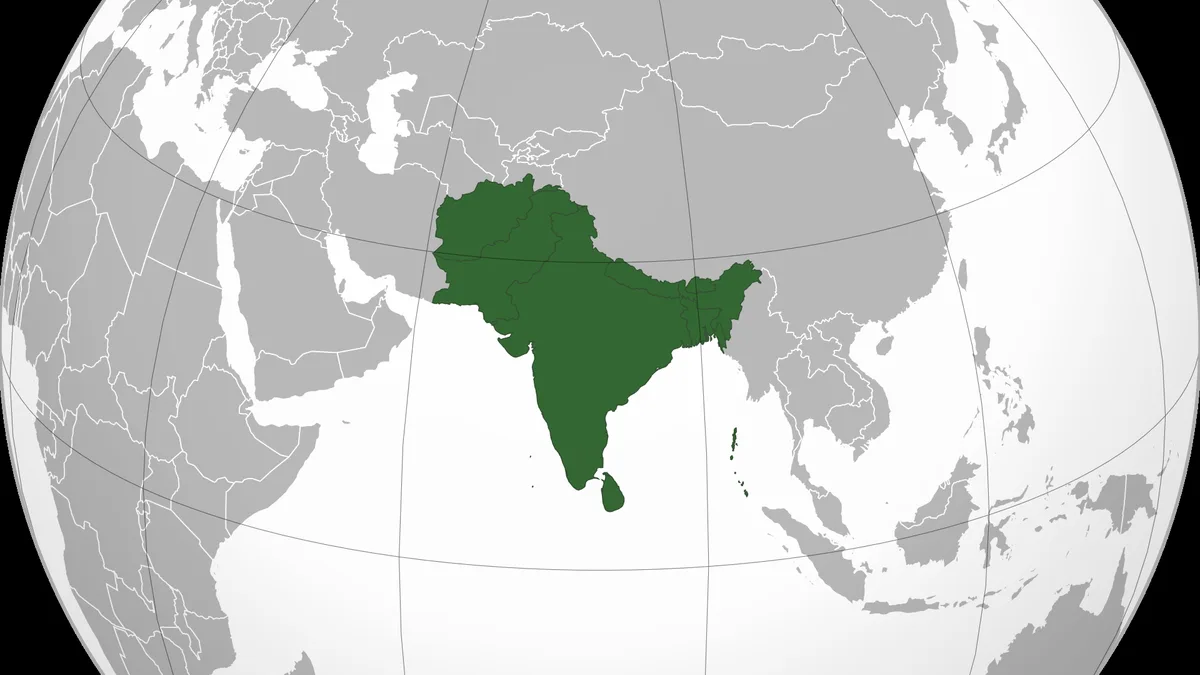
South Asia
| City market | Recall |
|---|---|
| Yield | Varies by season and crop |
| Foreign buyers permitted | Subject to local regulations |
| Country of origin | South Asia |
| Original use | Agricultural trade center |
| First documented | Ancient times |
| Primary goods traded | Agricultural produce, spices, textiles |
Origin and history
South Asia is not a city but a geographical and cultural region comprising modern nations including India, Pakistan, Bangladesh, Sri Lanka, Nepal, Bhutan, and the Maldives. Its history as a defined region stems from ancient geographical and civilizational commonalities rather than a single political entity. The concept of South Asia as a distinct region gained formal academic and geopolitical traction in the mid-twentieth century. This was partly influenced by the post-colonial realignment of the subcontinent and the establishment of regional organizations. The term itself is used to collectively describe an area historically referred to as the Indian subcontinent. The region's documented history spans several millennia, with some of the world's earliest urban civilizations, such as the Indus Valley Civilization, emerging there around the third millennium BCE.
What it is for
As a region, South Asia serves as a framework for geopolitical, economic, cultural, and environmental analysis and cooperation. It provides a collective identity for nations sharing historical ties, demographic flows, and similar developmental challenges. The region hosts the South Asian Association for Regional Cooperation (SAARC), an intergovernmental organization aimed at promoting economic and regional integration. Academically, the term is used to categorize studies in history, anthropology, political science, and economics specific to this part of the world. It also functions as a crucial unit for understanding shared climatic patterns, particularly the monsoon system that governs agriculture. Furthermore, the concept is essential for addressing transnational issues such as water management, security concerns, and public health initiatives across national borders.
Overview
South Asia is one of the world's most populous and densely populated regions, home to approximately one-quarter of the global population. It features extreme geographical diversity, encompassing the Himalayan mountain range, vast river plains like the Indo-Gangetic Plain, extensive coastlines, and arid deserts. The region exhibits immense linguistic, religious, and ethnic diversity, with hundreds of languages spoken and major world religions including Hinduism, Islam, Buddhism, and Sikhism having deep roots there. Economically, it contains a mix of rapidly growing economies and significant poverty, with a substantial informal sector. Urbanization is accelerating, leading to the growth of massive metropolitan areas such as Delhi, Dhaka, Karachi, and Mumbai. The region's collective economic output and market size make it a significant, though complex, global economic actor.
What to know
The "city market" in a South Asian context typically refers not to a single entity but to the collective consumer markets within the region's vast and growing urban centers. Market yield varies enormously between and within countries, influenced by factors like local purchasing power, infrastructure, and regulatory environments. Foreigners are generally permitted to buy consumer goods in local markets, but purchasing real estate or agricultural land is heavily restricted for non-citizens in most South Asian nations. Each country has distinct foreign direct investment (FDI) policies governing ownership in sectors like retail, manufacturing, and services. Navigating bureaucracy, understanding local business customs, and conducting thorough due diligence are critical for any market engagement. Intellectual property protection and contract enforcement standards can differ significantly from Western markets, posing operational challenges.
Common questions
A common question is whether South Asia is synonymous with India; it is not, as India is the largest country within a region that includes seven other sovereign states. People often inquire about a common language, but there is none, although English functions as a lingua franca for business and administration in many areas. Many ask about the safety and feasibility of foreign business operations, which requires country-specific and often sector-specific assessment rather than a regional generalization. Questions regarding market homogeneity arise, but the region is characterized by extreme diversity in consumer preferences, requiring localized strategies. Individuals frequently ask if a single regional visa exists for travel; there is not, and each country maintains its own visa regime. Another frequent inquiry concerns the primary economic sectors, which range from agriculture and textiles to advanced information technology and services, varying by country.
Pros and cons
A significant pro of engaging with South Asian markets is access to a massive and young consumer base with growing disposable income in key segments. The region offers competitive labor costs and a large pool of skilled professionals in fields like engineering and software development. However, a major con is the pervasive bureaucratic red tape and regulatory complexity, which can delay projects and increase operational costs substantially. Infrastructure deficits, particularly in transportation and consistent power supply, remain a persistent hurdle outside major urban centers. Political instability or sudden policy shifts in individual countries can alter the business landscape unexpectedly, creating uncertainty. A common mistake is treating the region as a monolithic market, leading to failed products or services that do not account for deep local variations in culture, language, and consumption patterns. Many who regret entering do so after underestimating the required patience, long-term commitment, and adaptation to local partnership models.
Who it suits
The South Asian market landscape suits large multinational corporations with the resources to navigate regulatory environments and invest in long-term market development. It is suitable for sourcing agents and manufacturers seeking cost-effective production in sectors like textiles, garments, and certain commodities. Tech firms looking to establish back-office operations or research and development centers find advantages in specific urban hubs known for technical talent. Development agencies and NGOs focused on poverty alleviation, public health, and education are inherently suited to work within the region due to the scale of need. The market is less suited for small or medium-sized foreign enterprises without prior regional experience or the capital for a sustained, learning-intensive entry. It best suits investors and businesses with high risk tolerance, cultural adaptability, and a strategy built on deep local partnerships rather than purely top-down control.
Latest South Asia news
Latest reporting
Greystar Names Tom Livelli Asia Pacific Head Amid Portfolio
US multifamily giant Greystar has appointed former EQT partner Tom Livelli as executive director and head of Asia Pacific, tasking him with leading...

Mirvac Names Kit Georgeos as Funds Management CEO
Mirvac has appointed Kit Georgeos as chief executive of its funds management division, effective 6 October. The move headlines a series of executive...

Pebblestone Bids $363M for Seoul's Hyde Park Myeongdong
South Korea's Pebblestone Asset Management is set to acquire the Hyde Park Myeongdong complex in Seoul for $363.4 million.

Heitman Hires John Lee to Lead Korea Capital Raising
Real estate fund manager Heitman has appointed John Lee, formerly of Koramco, to head its capital raising and investor relations efforts in South...

CapitaLand Targets $500M for Third Asia Pacific Credit Fund
CapitaLand Investment is seeking $500 million for its third Asia Pacific credit fund, focusing on senior secured, asset-backed real estate...

Eureka Group to Acquire NSW Land Lease Assets from Ingenia
Australian senior housing provider Eureka Group has agreed to buy six retirement properties in New South Wales from Ingenia Communities Group for...