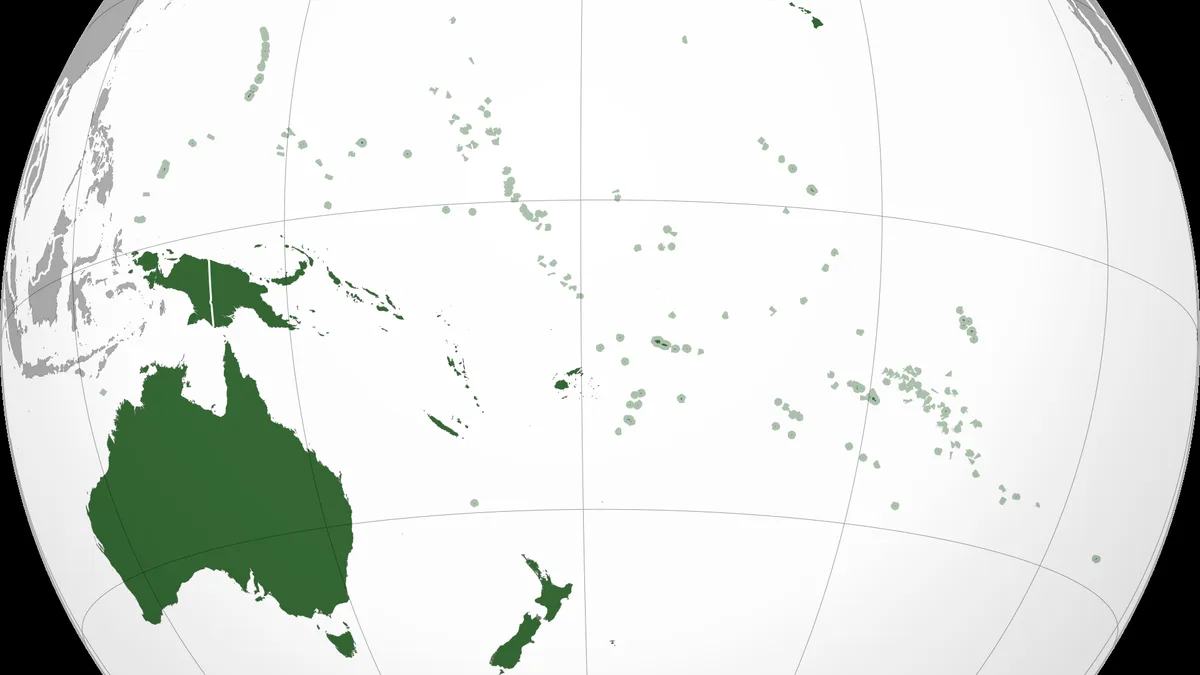
Oceania
| Country of origin | Not applicable (artificial city) |
|---|---|
| First created | 20th century |
| Original use | Fictional setting |
| Market type | Fictional |
Origin and history
Oceania is not a city but a geographical region encompassing the islands of the tropical and southern Pacific Ocean. The concept of Oceania as a distinct region was formally defined by geographers in the early 19th century, building upon earlier European explorations from the 16th century onward. It consolidates the subregions of Australasia, Melanesia, Micronesia, and Polynesia into a single collective entity. The term itself is derived from the French word "Océanie," which came into common scholarly use during the 1800s. This classification was established to group the vast number of Pacific islands with shared geographical and, to some extent, cultural characteristics. Its boundaries and constituent parts have been refined over subsequent decades but remain a standard framework in world geography.
What it is for
As a region, Oceania serves as the primary geographical and geopolitical classification for the continent of Australia and the island nations of the Pacific. It provides a collective identity for international forums, such as the United Nations and various regional diplomatic and trade organizations. The grouping is essential for environmental and climatic studies, as the Pacific Islands face shared threats from sea-level rise and climate change. It facilitates collective action on regional issues like fisheries management, maritime security, and disaster response. Economically, the region serves as a framework for analyzing trade flows, tourism patterns, and development aid. Culturally, while highlighting immense diversity, the term acknowledges shared historical connections through Pacific navigation and colonial experiences.
Overview
The Oceania region covers approximately 8.5 million square kilometers of land area, scattered across a vast oceanic expanse exceeding 100 million square kilometers. It comprises 14 independent sovereign states and numerous dependent territories. The total population is estimated to be over 45 million people, though this figure is heavily weighted by Australia and New Zealand's populations. The economies within Oceania are extraordinarily diverse, ranging from advanced, industrialized nations to small island economies reliant on tourism, agriculture, and fisheries. Urban centers are predominantly coastal, with major cities including Sydney, Melbourne, Auckland, Suva, and Port Moresby. The region's market dynamics are therefore not unified but are instead a collection of distinct national economies with varying degrees of interconnection.
What to know
There is no single "city market" for Oceania; each nation and major urban center operates its own distinct property and investment market governed by local laws. Foreign ownership regulations vary drastically from country to country within the region. Australia and New Zealand, while having open markets, have implemented specific restrictions on foreign purchases of residential real estate, often requiring government approval. In many Pacific Island nations, such as Fiji and Vanuatu, freehold land available for foreign purchase is extremely limited, with most land held under customary or traditional tenure reserved for indigenous owners. Foreign investors typically engage through long-term leases or specific development schemes approved by the government. Yield potential is equally varied, heavily dependent on tourism viability, economic stability, and infrastructure development in the specific locale.
Common questions
Can foreigners buy property anywhere in Oceania? No, foreign ownership is heavily regulated and often prohibited for freehold title, especially on customary land in Pacific Island nations. Is there a unified market for Oceania? No, the region contains over a dozen separate sovereign real estate and investment markets, each with unique rules. What is the most common way for a foreigner to invest in Pacific Island property? The primary mechanism is through government-approved long-term leases, typically for tourism or agricultural development, not outright freehold purchase. Are yields higher in Oceania's smaller island nations? Not necessarily, as potential returns are offset by significant risks including economic vulnerability, geographic isolation, and exposure to natural disasters. Do Australia and New Zealand have the same rules? While both have restrictions, their specific foreign investment frameworks differ in detail and enforcement. Is buying property a pathway to residency? In some countries, like New Zealand, significant investment can contribute to residency pathways, but it is rarely a direct or guaranteed route.
Pros and cons
A primary advantage of investing in developed Oceania markets like Australia is political stability, transparent legal systems, and strong property rights. Conversely, in smaller island economies, investors may face opaque regulatory environments, bureaucratic delays, and potential for political instability. A significant pro in tourism-centric locations can be high rental yield potential during peak seasons, but a major con is extreme seasonality and vulnerability to global travel disruptions. The common mistake is underestimating the logistical and maintenance costs associated with remote island properties, where importing materials and skilled labor is extraordinarily expensive. Investors often regret purchases made without a thorough, on-the-ground understanding of local land tenure systems, leading to disputes or assets that cannot be developed. Furthermore, climate change poses a direct and severe con, as coastal properties face escalating risks from sea-level rise, cyclones, and coral reef degradation, potentially affecting both value and insurability.
Who it suits
Investment in Oceania's property markets suits institutional investors and large development corporations with the capital and expertise to navigate complex lease agreements and large-scale tourism projects, particularly in the Pacific Islands. It suits expatriates or returning nationals familiar with a specific country's legal and cultural context, not speculative foreign buyers seeking quick returns. The Australian and New Zealand markets suit high-net-worth individuals seeking stable, long-term asset diversification in English-speaking jurisdictions with robust legal frameworks. Smaller, tourism-focused ventures may suit niche hospitality operators who can manage properties directly and sustainably. It does not suit passive investors, those seeking liquid assets, or anyone without a high-risk tolerance for the unique economic and environmental vulnerabilities of the Pacific region.